
Investment
ZED Mariel: the deep-water port and the long bet west of Havana.
A reading of Cuba's special development zone — scope, incentives, current tenants and strategic role in Caribbean logistics.
In preparation
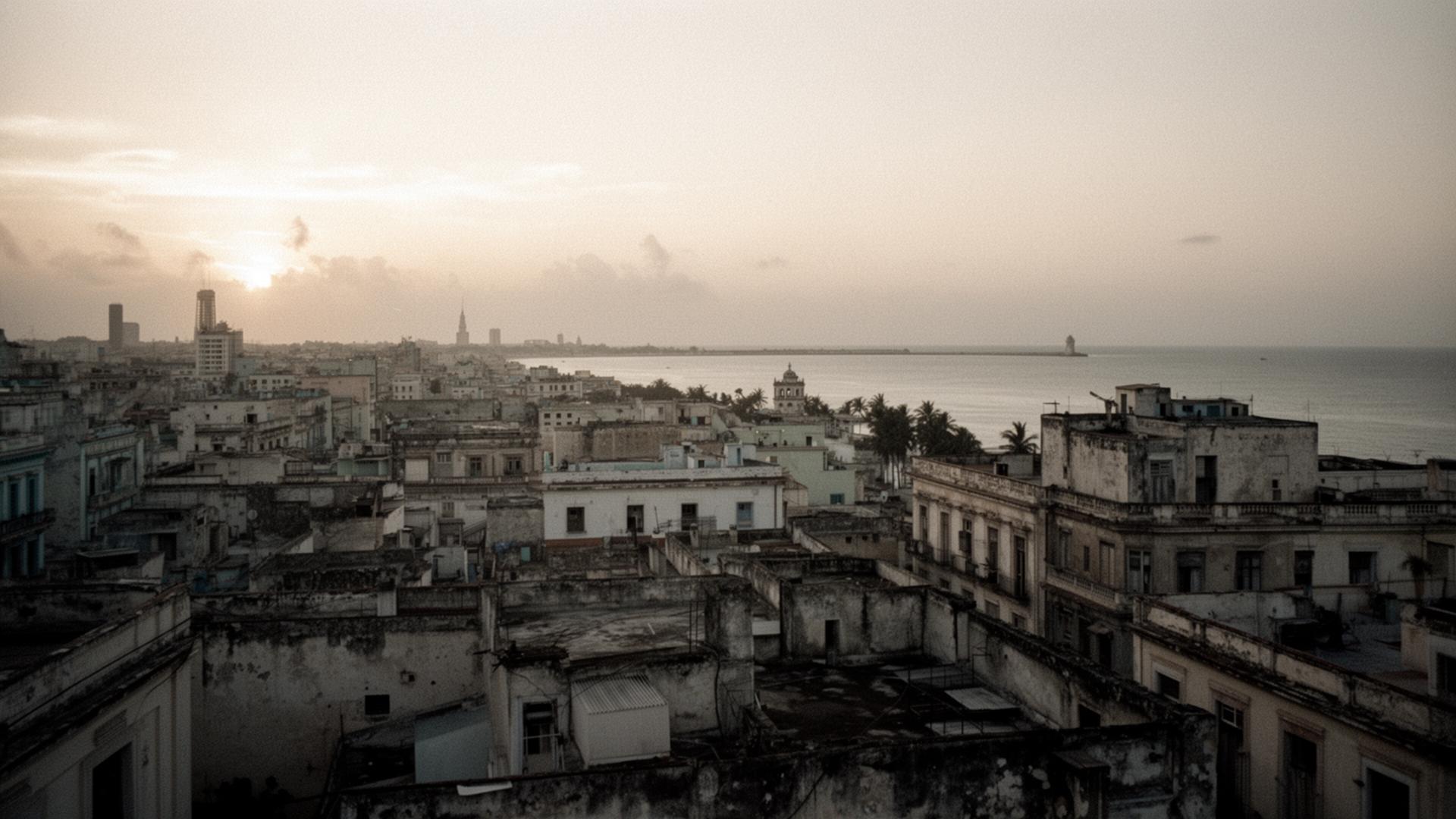
An independent platform on Cuba, its capital and its architecture — written for readers who want to understand the island before they consider it. Education first. Opportunity later.
For centuries, Cuba has occupied one of the most strategic positions in the Caribbean. Located roughly 150 kilometres from Florida, it sits at the intersection of North America, Latin America and the Caribbean.
Its geography, cultural influence, architectural heritage and global recognition have made Cuba one of the most fascinating countries in the Western Hemisphere.
Today, while much of the world focuses on headlines, Cuba remains a place of extraordinary complexity, identity and untapped potential.
Cuba is the largest island of the Antilles and the most populous nation in the Caribbean. Its northern coast faces the Florida Straits; its southern shore opens toward Jamaica and the Cayman Islands; its eastern tip looks across the Windward Passage to Hispaniola.
From Havana, Florida is a short flight. Mexico City, Bogotá, Santo Domingo and Panama are equally near. Few capitals sit at such a junction of routes.
Few small nations occupy as much imaginative space as Cuba. Old Havana and its fortifications were inscribed on the UNESCO World Heritage List in 1982 — joined in the years that followed by Trinidad, Viñales, Cienfuegos, Camagüey and the historic centre of Santiago de Cuba.
Tourism is among the country's most established sectors: in the years before the global pandemic, Cuba received more than four million international visitors annually, drawn by its cities, its coastline and its cultural depth.
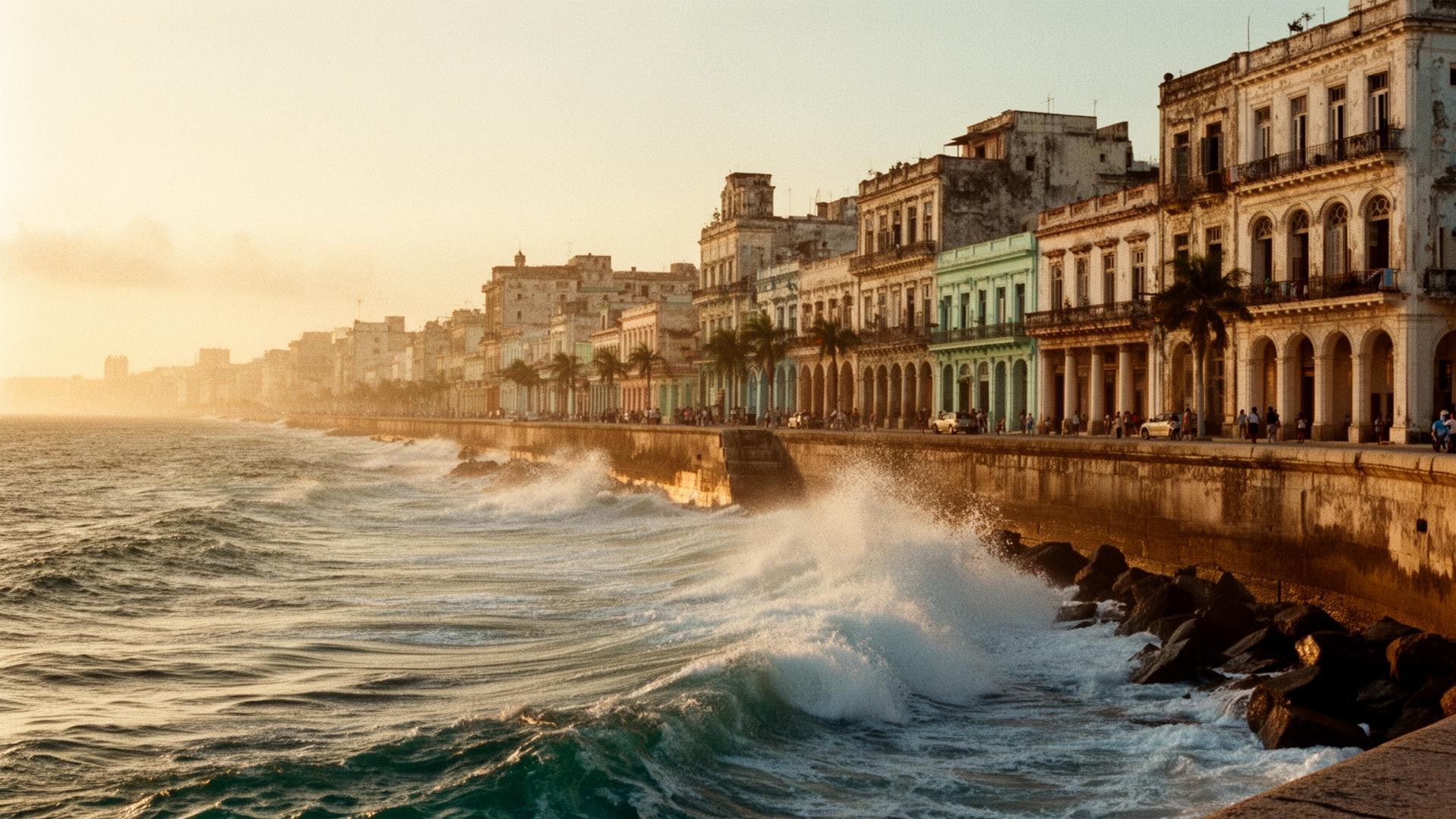
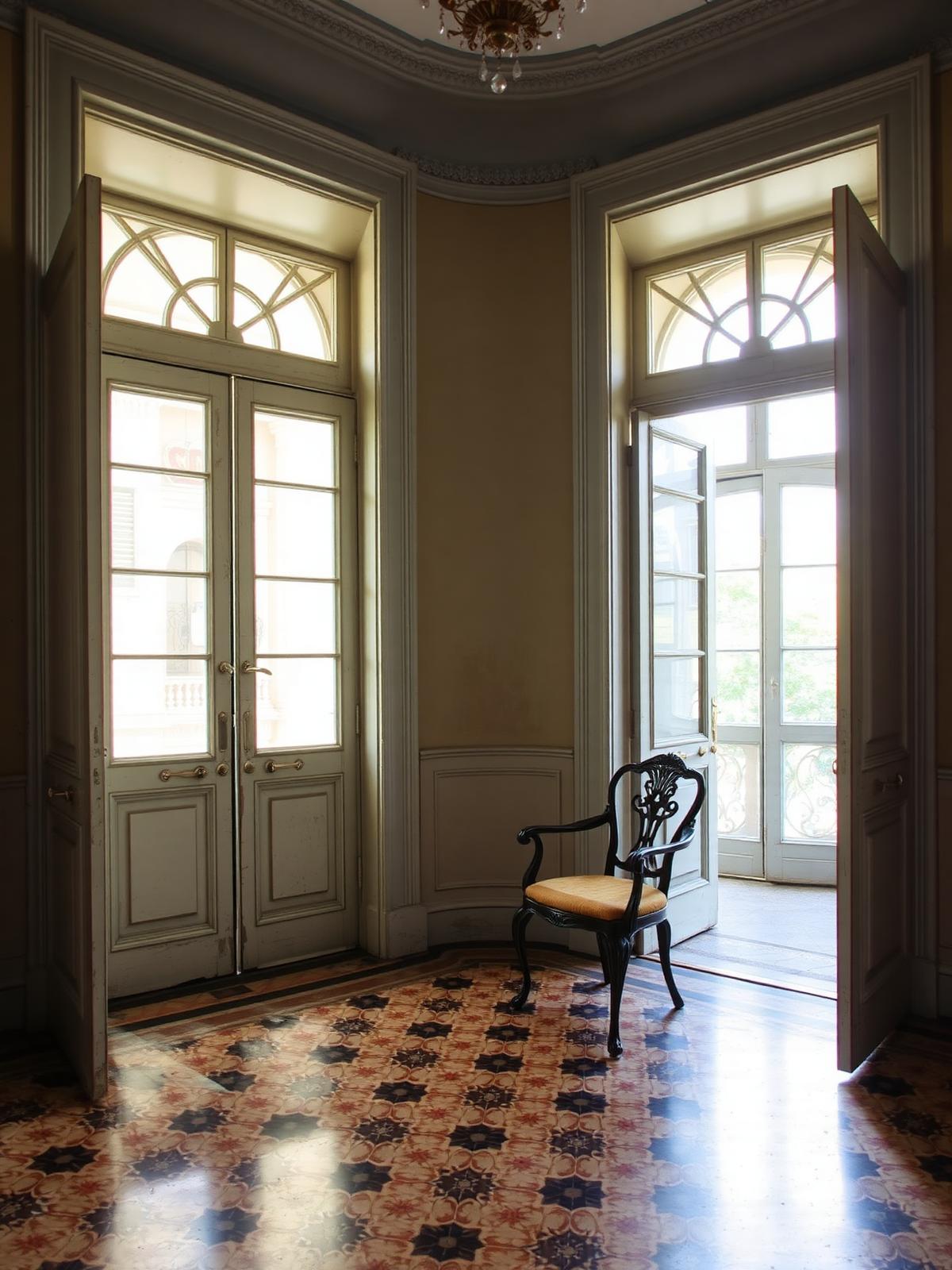
Cuba's built heritage spans nearly five centuries: Spanish colonial fortifications, neoclassical palaces, art nouveau and art déco facades, mid-century modernist towers. Whole quarters survive as ensembles rather than isolated monuments.
Restoration in Old Havana has been led for decades by the Oficina del Historiador de la Ciudad — a programme widely studied as a reference for heritage-led urban regeneration.
Son, danzón, mambo, chachachá, bolero, rumba, timba: Cuban music has shaped the sound of the twentieth century far beyond the island. Cuban son and rumba are both inscribed on UNESCO's Representative List of the Intangible Cultural Heritage of Humanity.
Add to this the country's long literary tradition — José Martí, Alejo Carpentier, Dulce María Loynaz — its cinema, its visual arts and the Bienal de La Habana, and the result is a small nation with an outsized cultural presence.
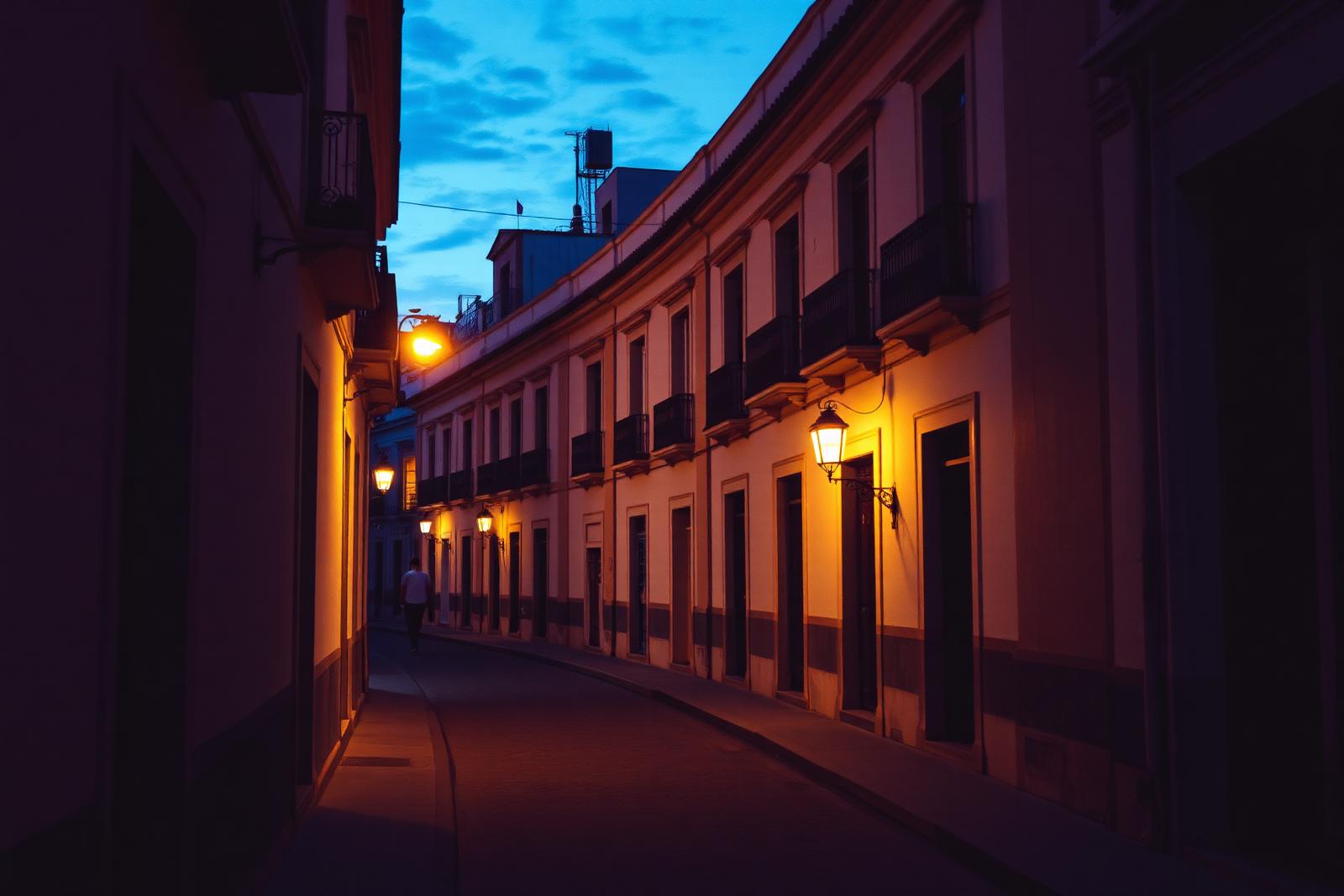
Cuba is not a market that reveals itself quickly. Documents, neighbourhoods, buildings and customs are read slowly, in person, and almost always with someone who has lived there long enough to recognise what is unusual and what is ordinary.
The platform exists to provide that context. It does not predict, it does not promise, and it does not accelerate. It collects knowledge, names, references and quiet introductions, and offers them to readers who treat time as part of the work.
Havana is more than Cuba's capital. It is one of the most architecturally distinctive cities in the Americas, home to centuries of history, extraordinary urban landscapes and some of the most iconic streets in the Caribbean.
Havana is not one city but a sequence of districts laid down across four centuries — from the walled colonial core founded in 1519 to the planned grid of Vedado and the early-twentieth-century avenues of Miramar. Each carries its own architecture, its own period, its own grain.
Select a district to read it.
The historic core, inscribed by UNESCO in 1982. Four founding squares — Plaza de Armas, Plaza Vieja, Plaza de San Francisco, Plaza de la Catedral — laid out between the late 16th and 18th centuries.
Old Havana and its system of fortifications were inscribed by UNESCO in 1982. Within its perimeter sit the four founding squares — Plaza de la Catedral, Plaza de Armas, Plaza Vieja and Plaza de San Francisco — and a near-continuous fabric of sixteenth to nineteenth-century buildings.
Few historic centres in the Americas survive so densely intact, or carry such a sustained tradition of public restoration.
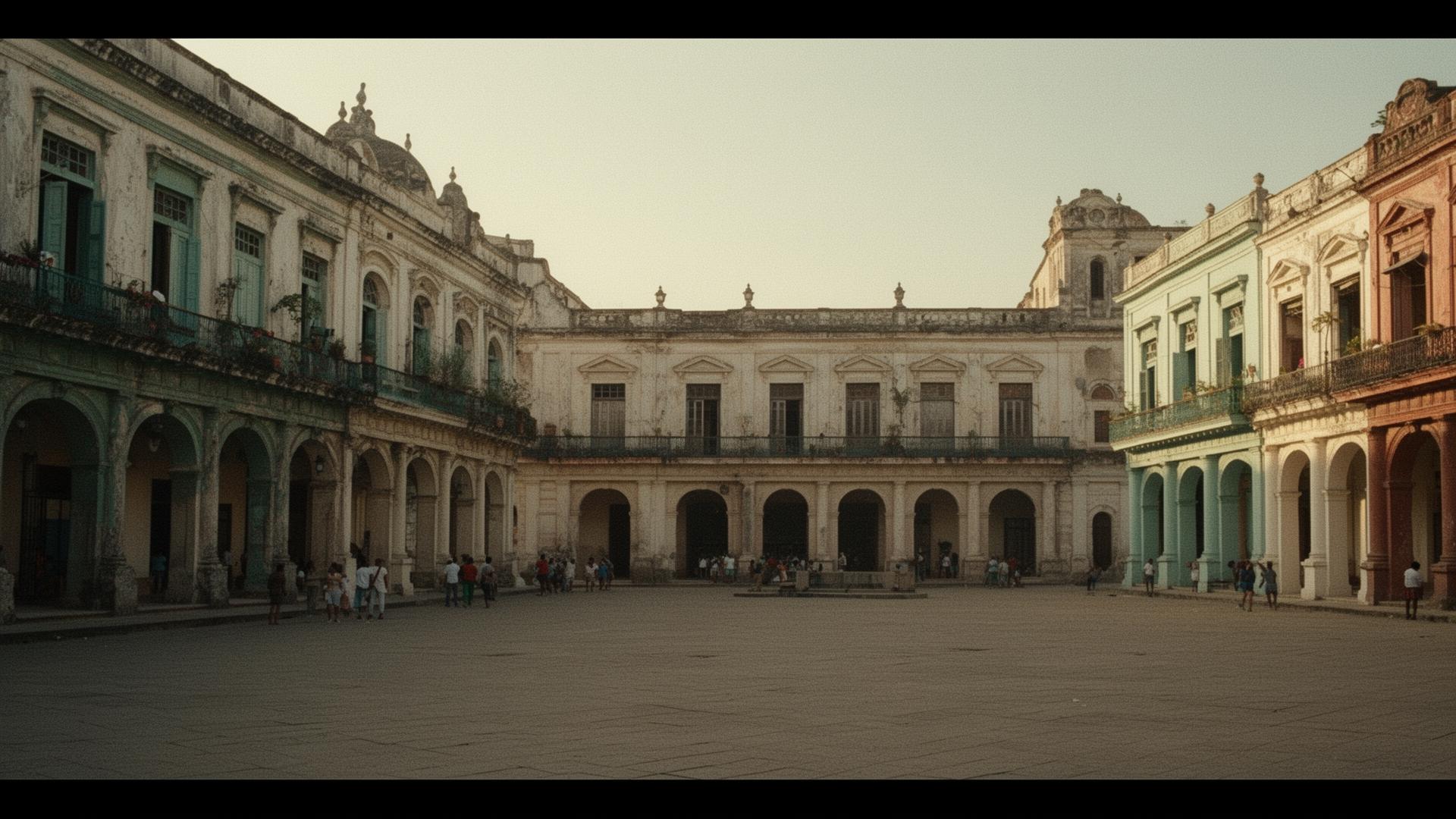
Havana's colonial houses are organised around an interior patio, with arcaded loggias, tall louvred windows and stained-glass fanlights — mediopuntos — that filter the Caribbean light. Walls are thick; ceilings reach four or five metres.
Restored or unrestored, these buildings share a vocabulary: limestone, wrought iron, hydraulic tile, mahogany. The discipline lies in working with it, not against it.
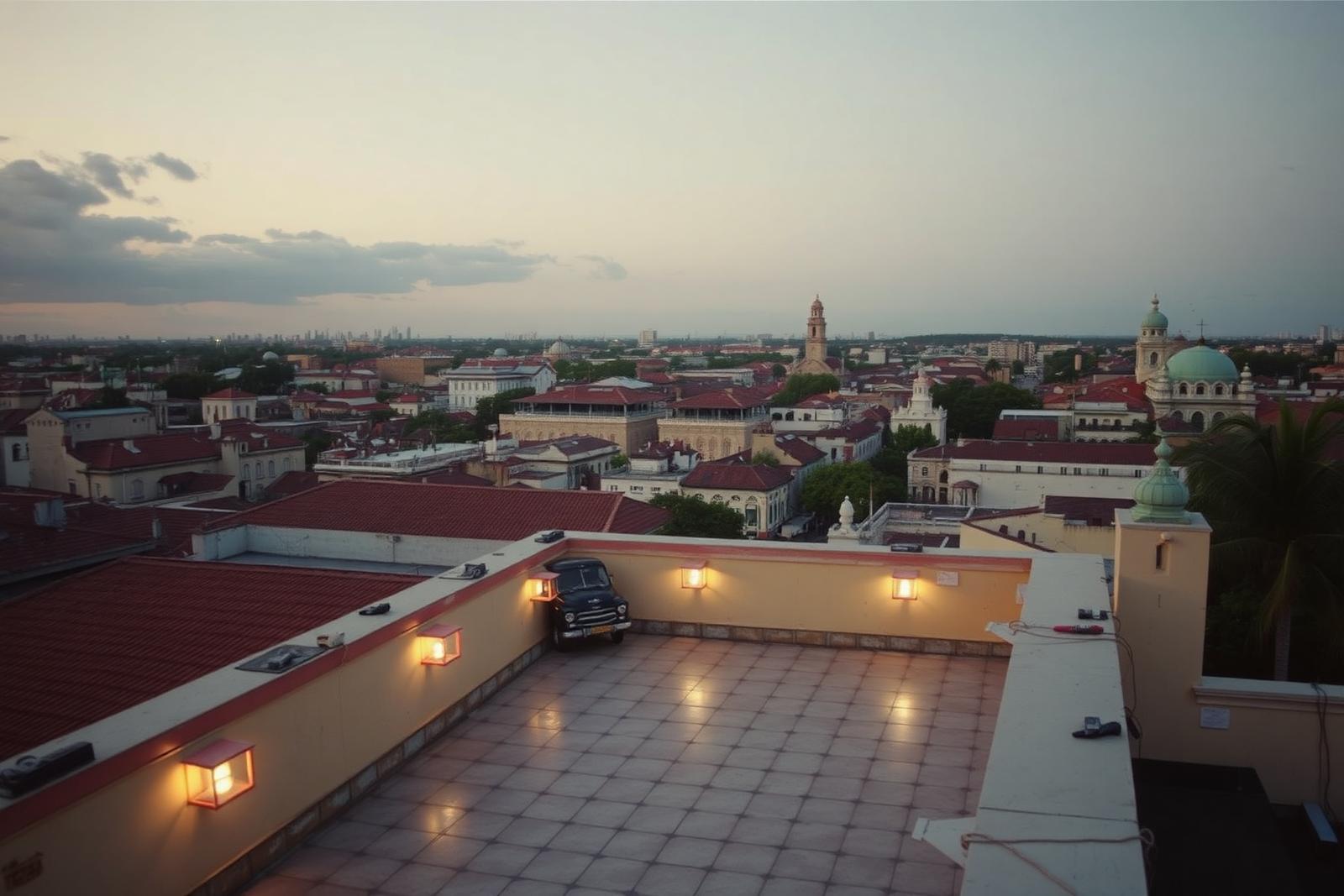
Above the historic core lies a second city of terraces, water tanks, washing lines and improvised gardens. From a rooftop in Habana Vieja the eye crosses the dome of the Capitolio, the spires of the Cathedral, the Morro lighthouse and the long horizon of the Florida Straits.
In recent years, rooftops have become quiet stages for restaurants, bars and private terraces — a vertical extension of the street life below.
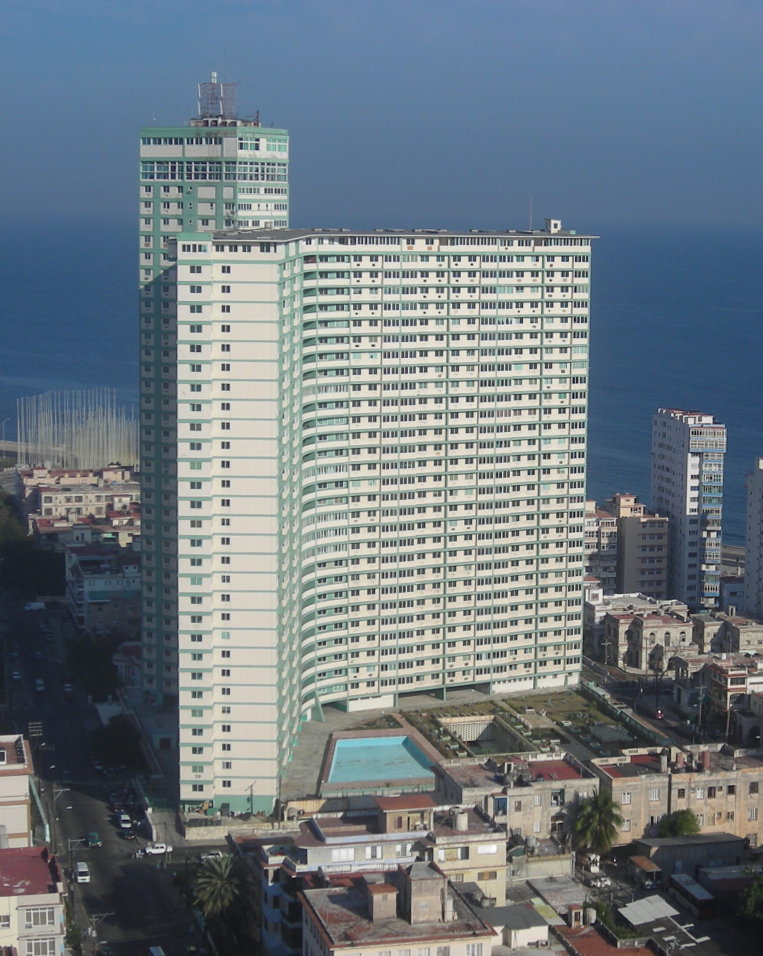
Completed in 1956 in the Vedado district, the Edificio FOCSA was designed by the architect Ernesto Gómez-Sampera with Martín Domínguez Esteban. At thirty-nine storeys and roughly 121 metres, it was for years one of the largest reinforced-concrete residential structures in the world.
Conceived as a city within a building — apartments, shops, a school, a restaurant and a rooftop terrace overlooking the Malecón — FOCSA remains a defining presence on the Havana skyline and a reference point of twentieth-century Cuban architecture.
Havana's architecture is not a single style but a sequence of periods — each leaving its own vocabulary, its own materials, its own scale. From the sixteenth-century colonial core to the modernist towers of the 1950s.
Select an era to read it.
Spanish military and religious architecture. Fortresses, churches and townhouses organised around interior patios. Thick walls, arcaded loggias, stained-glass fanlights — mediopuntos — that filter the Caribbean light.
Six cultural inscriptions, two natural sites and one cultural landscape. A map of Cuba's exceptional value — not only in Havana but across the island from Pinar del Río to Baracoa.
Select a site to read it.
The historic centre of Havana, founded in 1519. Four founding squares and a near-continuous fabric of sixteenth to nineteenth-century buildings.
A quiet colonial street running between the old city walls and the harbour, lined with eighteenth and nineteenth-century townhouses. Its scale — narrow, shaded, residential — is the calm counterpoint to the busier arteries nearby.
The historic spine of Old Havana, connecting the Plaza de Armas to the Parque Central. Pedestrian for much of its length, Obispo is the city's living arcade: bookshops, pharmacies, the old Hotel Ambos Mundos, the rhythm of musicians and passers-by.
A north–south colonial street crossing the heart of the old city, named for the avocado tree. Aguacate carries the layered facades, balconies and grilles that give Habana Vieja its characteristic texture between the four founding squares.
Laid out in 1559 as the Plaza Nueva, it became a civic square of Havana before being renamed Plaza Vieja in the eighteenth century. Surrounded by baroque and art nouveau buildings, it is one of the most thoroughly restored ensembles in the historic centre.
The other half is its people. Conversations on doorsteps, dominos under arcades, music drifting from upstairs windows, the slow choreography of a morning in Centro Habana — the city is inhabited at street level in a way that few capitals still are.
To understand Havana is to spend time in it: in cafés, on benches, in entrance halls and on staircases. The buildings make sense only once the daily life inside them is felt.
Cuba's market opacity is not an obstacle to be removed; it is the condition of the opportunity. Access is proportionate to the depth of one's relationships.
Havana does not reward velocity. The buildings here are three centuries old; the positions one takes within them should be considered against the same scale.
Title, structure, neighbourhood, custom — none of these are legible without a resident reading. We do not promise returns; we offer the conditions under which considered judgement becomes possible.
The opportunities worth considering rarely appear in public listings. They are introduced, examined and considered over time, between trusted parties.
Not a portfolio. A reading list of the themes through which we approach the island.
Eighteenth and nineteenth-century palazzos within the UNESCO perimeter. Patios, columns, original azulejos.
Vertical expansion above the historic core. Quiet terraces with views of bell towers and the sea wall.
Curated lodging concepts of fewer than twelve keys, embedded in the fabric of historic neighbourhoods.
Long-stay residences for the traveller who returns. Architectural quality, residential cadence.
Restoration-grade buildings and ensembles with the scale to anchor a quarter for a generation.
Quiet introductions. Buildings considered over months, never advertised, considered between trusted parties.
Long-form editorial in English — full translation in progress.
A reading of Cuba's special development zone — scope, incentives, current tenants and strategic role in Caribbean logistics.
How the historic centre is funded, how Habaguanex reinvests, and what foreign capital can — and cannot — touch.
Remittance flows, the MIPYMES decree of 2021, and the patterns we are observing among Cuban-Americans and Europeans returning with capital.
An education-first guide to the three legal vehicles a foreigner can use to hold real estate on the island after the June 2026 reforms — and to the registry, fiscal and political risks the legal text leaves uncovered.
Founders with hospitality, cultural or restoration projects of singular character.
Multi-generational capital placing patient allocations into heritage assets.
Allocators with a horizon measured in decades, not quarters.
Practices that treat restoration as a craft and a contribution.
Those returning, with memory, to participate in the next chapter.
Institutions and individuals investing in the continuity of place.
This is not a platform for the hurried, nor for those who confuse a quick return with a considered one.
Owners of buildings, ensembles and concepts of architectural or strategic value are welcome to begin a discreet conversation with the Gateway.
We do not list. We do not market. Each introduction is considered slowly, against the standards of those we work with.
What the owner receives is a single, qualified introduction — brought with full context, complete discretion and the patience that a serious position requires.
Everything begins through correspondence — by referral, or by a single, considered letter.
If you leave this page understanding Cuba a little better than when you arrived, the Gateway has done its work.
Everything else — neighbourhoods, buildings, opportunities — follows from that.